Sebastian Schauscheill
Lords of ChaosSebastian Schauscheill was a member of the East German Black Metal band Absurd and one of three teenagers convicted of murdering their schoolmate Sandro Beyer in 1993. His story sits at the intersection of a small youth clique, a music scene built partly around transgressive identity, and a media response that recast a personal killing as a Satanic crime. The evidence presents Schauscheill not as a simple embodiment of that public image, but as a participant in a group whose private conflicts turned lethal and whose members’ explanations did not fit the headlines made in their name.
Background and Place in Absurd
After the Berlin Wall fell in 1989, records and videos previously unavailable in East Germany became easier to obtain. In Sondershausen, in Thuringia, Schauscheill, Hendrik Möbus, and Andreas Kirchner—each 17—attracted attention for their interest in extreme Heavy Metal, occultism, horror films, and Satanic imagery. Other young people in town, including left-wing punks and right-wing skinheads, antagonized them, while local schoolgirls became admirers. The three formed the core of Absurd, a band whose identity drew on the dark, confrontational style then associated with Black Metal.
The group’s activities took place in a wider local network rather than in isolation. Its members met with a small circle of adherents, sometimes at a rock quarry where they reportedly held Satanic baptism ceremonies. For a time, Absurd rehearsed at the Youth Center, where arguments also occurred with members of a Christian Youth Club. The group’s reputation was cultivated through both music and provocation; a high school fanzine interview in late 1992, for example, gave Möbus an opportunity to publicly distance Absurd from Sandro Beyer, whom the band did not accept. Such performances of belonging and exclusion formed part of the social setting in which Schauscheill and his companions came to regard Beyer as a persistent problem.
Schauscheill’s connections to the Norwegian scene were real but qualified. In a later account, he said Absurd had taken less musical influence from Norwegian bands than from their way of life: their fierce, dark opposition to the Christianized modern world and their resistance to the music business. He recalled a strong relationship with Norwegian musicians and reported that Øystein Aarseth had wanted to sign Absurd to Deathlike Silence Productions after hearing the band’s Death from the Forest demo. This retrospective attachment placed Absurd within an international subculture, even as the group’s defining crime arose from local relationships in Sondershausen.
Sandro Beyer and the Breakdown of the Group
Beyer, who was 14 when he became fascinated by Absurd and its associates, tried to enter their circle. He asked to attend rehearsals and corresponded with the young people around the band. The group never accepted him; its members displayed their dislike, while Beyer’s attempts to ingratiate himself increasingly gave way to arguments and taunts. After his parents objected to his new interests—his father once burned a pentagram T-shirt—Beyer said he would stop associating with the group and discarded his Satanic objects. Yet he remained drawn to the people who had rejected him.
The estrangement became an active feud. Alongside a young girl named Rita, Beyer began trying to embarrass Möbus and Schauscheill through slanderous letters and rumors. He knew Schauscheill was having an affair with Heidegrit Goldhardt, an older married woman and evangelical Christian schoolteacher who was pregnant with Schauscheill’s child, and threatened to expose the relationship. Schauscheill responded with written threats, invoking sorcery and warning Beyer to stay away. The exchange turned a strained social relationship into an explicit confrontation, with the threatened disclosure giving the dispute a specific personal stake.
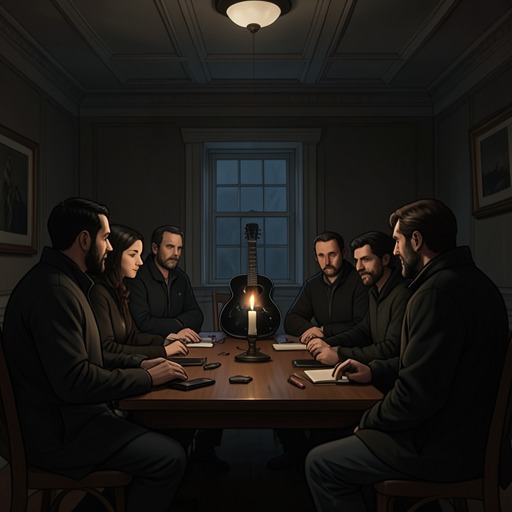
Schauscheill’s life did not fit a single, consistent public pose. Alongside his involvement with Absurd, he joined Goldhardt in environmental and animal-rights causes and wrote polemical letters to newspapers. At night, according to the account of the group, he rehearsed Luciferian songs and drank with the band; one drunken gathering ended with the youths breaking into and damaging an empty house. These contrasting activities do not explain the murder, but they show the range of identities and settings coexisting around him. The book’s account also records a close group consensus that Beyer had become intolerable. Schauscheill later told police that Beyer’s manner and appearance had begun to get on their nerves and that, because the group was fixated on him, an idea had formed.
The Murder and Its Explanations
On the night of the killing, the youths led Beyer through the woods to a bungalow belonging to Möbus’s father. They invited him inside, presenting the meeting as a discussion. When Beyer tried to leave, Andreas Kirchner seized an electrical cord; the account alleges that Möbus also used a knife. The three then restrained Beyer, and Schauscheill and Kirchner used the cord to kill him. They moved the body to a shed near a creek and left for the night. After Beyer’s parents and the police began searching, the three returned the next day, carried the body wrapped in a blanket to a nearby excavation pit, and buried it. It was found almost immediately, and the investigation led to Schauscheill, Möbus, and Kirchner.
At first, the killing appeared to the press as material for a Satanic-sacrifice narrative. Schauscheill’s account of the crime did not support that interpretation. He said the idea of killing Beyer had arisen about a week beforehand, but described the act itself as relatively spontaneous and without a logical motive. He also suggested it felt like an internal compulsion. When asked whether Black Metal’s violent imagery had influenced the group, he allowed that it might have played a minor part but did not regard Heavy Metal as a principal cause. He separately recounted hearing an unclear voice in his head about six months before the murder and later interpreting its phrase as a command to kill Beyer. That account is evidence of what Schauscheill said, not an independently established explanation for the crime.
Trial, Sentence, and Public Meaning
Because the three defendants were 17, they were tried under youth laws, which limited detention to ten years even in cases of mass murder. Their trial began in early 1994 and became a major media spectacle. The court convicted them of first-degree murder, deprivation of liberty, threat and duress, and bodily injury. Schauscheill and Möbus each received eight years of detention; Kirchner received six. All three were released before serving their full sentences.
The case became part of a broader dispute about how Black Metal and Satanism were represented. Reports described the killing in the language of Satanic sacrifice, while Schauscheill’s own explanation emphasized personal fixation, group dynamics, and an act he could not give a logical rationale. The distinction matters: the band’s imagery and the young men’s chosen identities belonged to the story, but the evidence does not establish Satanism as the motive. Schauscheill’s trajectory instead exposes the gap between a deliberately sinister scene persona and the concrete pressures of a local feud—and the ease with which sensational coverage could make that gap disappear.